(15 marks)
Extract 1 Growth of renewable energy in the UK
Renewable energy currently makes up around 16% of UK electricity supply. More than half of this comes from wind power – the UK has more wind potential than any other country in Europe. Production of renewable energy is set to increase significantly over the next fifteen years to exceed 30% of total electricity generation. Most coal power stations are set to be phased out by 2030 helping to reduce carbon emissions whilst gas supplies appear unreliable in the current political climate.
Wind, wave and tidal power currently provides employment for 34 500 people in the UK and is expected to create a further 70 000 jobs over the next decade. The economic benefits from such growth will be spread across the UK. The German company Siemens, for example, has announced plans to invest £160 million in building a wind turbine factory in Hull, in the north of England. Its partner in the project, Associated British Ports, will invest a further £150 million in local infrastructure. Together, they will directly create 1 000 jobs in a city hit hard by unemployment and poverty. Hull will become one of the world’s leading locations for the production of wind turbines. The work involves many types of specialist jobs such as designers, engineers, welders, electricians and truck drivers.
Division of labour is breaking down the steps of the production process after a firm or country specialises.
Workers will benefit from the division of labour in the wind turbine firms because it will lead to a better quality of life for them, via higher incomes. According to extract 1, the German company Siemens announced plans to invest £160 million in building a wind turbine factory in Hull and its partner Associated British Ports will invest £150 million in infrastructure, directly creating 1000 jobs. ‘The work involves many types of specialist jobs’. This means be dividing the labour, workers at the wind turbine firm would most likely get better at their jobs and work more efficiently. If they worked more efficiently, the wind turbine firm would see an increase in output over time which would generate more revenue for the firm. If efficiency increases, it means the costs of production are going to decrease, demonstrated on the graph below. As you can see on this graph the cost of production decreases and the supply curve shifts right, reducing price for consumers and increasing output for the wind turbines. This higher revenue and decreased costs means the firm witnesses increased profits, leading to higher wages/salaries for the workers. This in turn leads to an increased quality of life as these workers are able to purchase more goods and services or more luxurious goods and services.

However, an increase in profit only benefits workers if the firm decides to use that money to increase the wages and/or salaries of the workers. If the wind turbine firm’s shareholders decide to keep the profits for themselves, the workers wouldn’t benefit because they wouldn’t see that payment increase that allows them to purchase more or better items. Furthermore, this assumes that other costs are ceteris paribus (remain the same). For example, although the output of the firm increases, the transportation costs of storage and maintenance costs for the wind turbines may also increase, causing the new profit not to be as great as they would be otherwise. This means with less profits, if the payments of the workers was to increase it wouldn’t be as much as it could without the effects of those other costs.
Consumers also benefit from the division of labour because it creates new jobs for less skilled individuals who wouldn’t be technically skilled enough to be employed otherwise. In extract 1 it says ‘the work involves many types of specialist jobs such as designers, engineers, welders, electricians and truck drivers.’. This shows that by dividing the work new job opportunities can be created for those less skilled individuals, for example truck driving. In a wind turbine firm a lot of the work is very technical and requires extensive training and schooling if there was no division of labour. However, if the labour was divided it could provide those without the necessary qualifications a less technical career route. This benefits the consumer as they won’t be unemployed anymore and earning a wage or salary. This can give the individual financial confidence as they are earning an income rather than relying on state provided benefits. Also it can improve their quality of life as they now can afford more or nicer things.
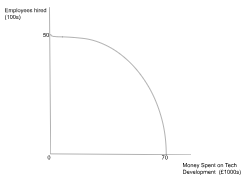
However, this relies on whether the firm decides to spend more money on employees or on other parts of the business. For example, if the wind turbine firm decides that they want to invest in more maintenance for the wind turbines or even in better better technology for manufacturing the wind turbines.This would mean there wouldn’t be that job vacancy for the unemployed consumer because the firm spent their money elsewhere, creating an opportunity cost (next best alternative foregone). This is seen on the PPF diagram below for the wind turbine firm. If they invested £70,000 in tech development (as a theoretical example), they would no longer be able to higher any employees due to the opportunity cost it creates and vice versa. If they hired 5000 new employees they would no longer be able to invest that money they used into the development of new technologies.


 Mind Over Markets
Leave a reply to Samuel Cancel reply