Tag: politics

  • 🎓Rwanda’s Economic Transformation: Lessons from Home

    When people talk about “economic development,” it often feels like a distant concept—numbers in textbooks, models on lecture slides, or case studies about countries we’ve never visited. But for me, economic development is not just theory; it’s lived reality. As a Rwandan, I’ve seen my country change rapidly in just a few decades, and Rwanda’s story is now a fascinating case study for anyone interested in development economics.

    📈From Tragedy to Transformation

    In 1994, Rwanda’s economy quite literally collapsed. The genocide against the Tutsi destroyed not only lives but also institutions, infrastructure, and social trust. GDP shrank by more than half in a single year, and for many outsiders, Rwanda seemed destined for permanent poverty.

    But the story didn’t end there. In the years that followed, Rwanda rebuilt itself through a combination of strong governance, forward-looking policy, and international partnerships. Since the early 2000s, Rwanda has consistently achieved growth rates of 7–8% per year, one of the fastest in Africa.
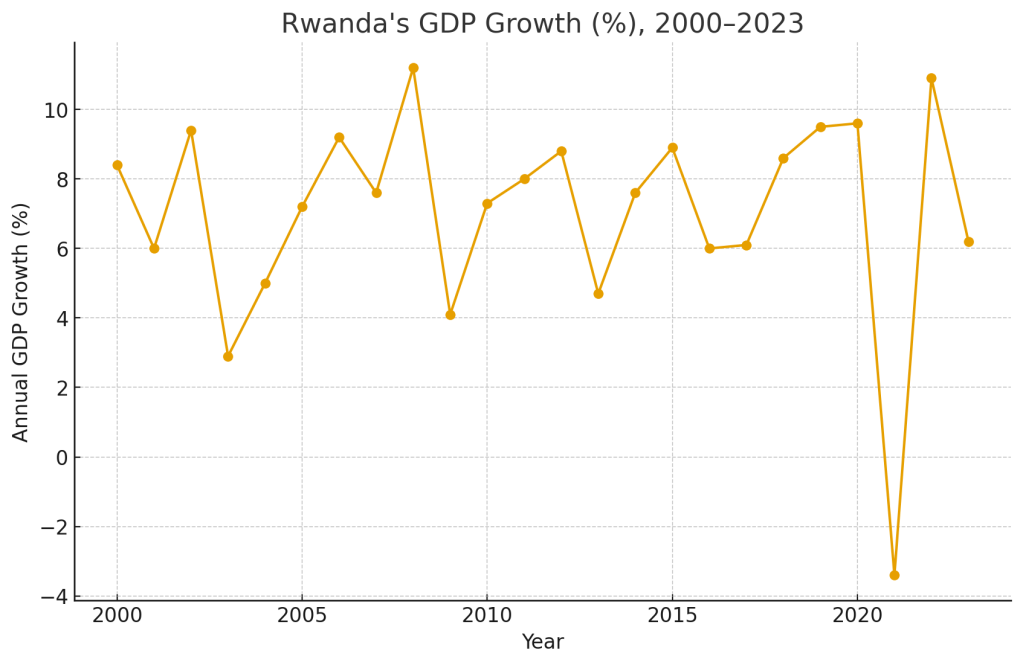
    This transformation raises important questions for development economists: how can a resource-scarce, landlocked country overcome the odds? Which policy choices make the difference between stagnation and sustained growth?

    🌹The Policy Foundations of Growth

    Rwanda’s progress rests on several pillars:

    1. Good Governance and Low Corruption
      Unlike many post-conflict states, Rwanda put governance at the centre of its strategy. Through strict anti-corruption measures and an emphasis on performance contracts for public officials (known as imihigo), the government created institutions that people could trust. Transparency International now ranks Rwanda among Africa’s least corrupt countries.
    2. 🧠Human Capital Investment
      Economic development is ultimately about people. Rwanda prioritised education and healthcare, extending universal primary education and implementing community-based health insurance (mutuelles de santé). These policies have helped raise literacy rates and life expectancy, creating a healthier, more skilled workforce.
    3. Infrastructure and Technology
      From roads to internet connectivity, infrastructure investment has been central. Rwanda has branded itself the “Singapore of Africa,” focusing on efficiency, digital governance, and ICT innovation. Initiatives like the Kigali Innovation City aim to attract tech companies and position Rwanda as an East African tech hub.

    Engines of Economic Growth

    So where is growth actually coming from?

    • 🌱Agriculture remains the backbone of the economy, employing around 70% of the population. Reforms such as land consolidation and crop intensification have raised productivity, though food security remains an ongoing challenge.
    • Tourism and Services have expanded rapidly. Rwanda has become a high-end eco-tourism destination, with gorilla trekking in Volcanoes National Park as its flagship attraction. Kigali has also positioned itself as a regional hub for conferences and international meetings.
    • 🤖Finance and Innovation are growing areas. Mobile money has transformed everyday transactions, while fintech start-ups are beginning to attract investment. Rwanda is part of the African Continental Free Trade Area (AfCFTA), which may open new opportunities for trade and services.

    ⛅Challenges on the Horizon

    Of course, rapid growth does not mean Rwanda’s development story is complete. Some key challenges remain:

    • Poverty and Inequality: Despite growth, many Rwandans remain in subsistence farming, and bridging the rural-urban divide is essential for inclusive development.
    • 🩹Dependence on Aid: Foreign aid still plays a significant role in financing public investment, raising questions about long-term sustainability.
    • 🏛️Small Domestic Market: With just over 13 million people, Rwanda’s market is limited, so integration with regional and global markets is vital.
    • Climate Vulnerability: As an agrarian economy, Rwanda is especially exposed to climate shocks, making sustainability a pressing issue.

    Why Rwanda is a Case Study Worth Watching

    For students of economics and development, Rwanda is a fascinating laboratory. It demonstrates how institutions and governance—not just natural resources or geography—can shape economic outcomes. It also challenges traditional development narratives, showing that a country with limited physical endowments can still achieve rapid growth through smart policy.

    And for me personally, Rwanda’s story is not just data or policy analysis—it’s home. Every new road I’ve seen built, every young entrepreneur I’ve met in Kigali’s growing startup scene, and every success story from rural farmers reminds me that economic development is ultimately about improving people’s lives.

    ⚘Looking Forward

    The next stage of Rwanda’s economic journey will depend on moving from growth to transformation: building a knowledge-based economy, reducing inequality, and ensuring that development is environmentally sustainable. If successful, Rwanda could become a model for other small, resource-scarce nations facing similar challenges.

    For students like me, Rwanda’s story isn’t just inspiring—it’s an invitation. An invitation to study how economics can be applied in practice, how development can be shaped by policy choices, and how a nation’s trajectory can be changed by determination and vision.

    Leave a comment

  • 🎓A Day at the Bank of England Museum: Thinking About the Future of Money

    One of the advantages of being in London is how close you are to the institutions that shape the economy. As a 16-year-old student aiming to study economics at Imperial and eventually become an investment banker, I’ve been trying to make the most of that. Recently, I had the chance to visit the Bank of England Museum, and it turned out to be one of those experiences that stays with you.

    📲The Event: The Future of Money

    The highlight of the day was an event on the Bank’s newest installation: the future of money. A museum curator explained how money is evolving, and it wasn’t just about cryptocurrencies or buzzwords — it was about the bigger picture:

    • 💳How a digital pound (CBDC) could transform the way we transact.
    • 💸Why cash still matters in a digital economy — for identity, inclusion, and trust.
    • 💰And how at the core of it all, money only works because we believe in it.

    Hearing this in the very building where decisions about interest rates and monetary stability are made was powerful. It reminded me that finance isn’t just about numbers on a screen — it’s about trust. And in investment banking, where you’re advising clients and allocating capital, that trust is everything.

    Touring the Museum

    After the talk, I went on a tour of the museum. Some moments stood out:

    • 🪙Trying to lift a gold bar — it’s far heavier than you’d expect. It made me think about wealth in its most physical form.
    • 💷Seeing the evolution of banknotes from the 17th century to today’s polymer notes. It showed me that money always adapts to technology and society.
    • 💹Exhibits on inflation and monetary policy, which connected directly to what I’ve been studying. It was a reminder that behind every rate change headline are real decisions impacting households, businesses, and markets.

    Beyond Economics: Networking and Confidence

    What I didn’t expect to take away was how valuable it felt to talk to professionals in that environment. Asking the curator questions about digital currencies gave me practice in having conversations with people who live and breathe finance.

    For aspiring bankers, this is huge. Networking isn’t just about LinkedIn or formal events — it starts with being curious, asking good questions, and building confidence in professional settings. Experiences like this are more than just educational; they’re training for the world we want to work in.

    🤔Final Thoughts

    Leaving the Bank of England, I realised how important it is for aspiring finance professionals to understand both the history and the future of money. The visit reinforced that finance is built on trust, shaped by innovation, and grounded in the decisions of institutions like the Bank.

    For me, the museum wasn’t just a tour — it was a reminder that if I want to succeed in investment banking, I need to keep looking ahead, stay curious, and develop the confidence to engage with the world of finance now, not just later.

  • Assess the likely benefits of the division of labour in the production of wind turbines. (Specialisation and Division of Labour)

    (15 marks)

    Extract 1 Growth of renewable energy in the UK 

    Renewable energy currently makes up around 16% of UK electricity supply. More than half of this comes from wind power – the UK has more wind potential than any other country in Europe. Production of renewable energy is set to increase significantly over the next fifteen years to exceed 30% of total electricity generation. Most coal power stations are set to be phased out by 2030 helping to reduce carbon emissions whilst gas supplies appear unreliable in the current political climate. 

    Wind, wave and tidal power currently provides employment for 34 500 people in the UK and is expected to create a further 70 000 jobs over the next decade. The economic benefits from such growth will be spread across the UK. The German company Siemens, for example, has announced plans to invest £160 million in building a wind turbine factory in Hull, in the north of England. Its partner in the project, Associated British Ports, will invest a further £150 million in local infrastructure. Together, they will directly create 1 000 jobs in a city hit hard by unemployment and poverty. Hull will become one of the world’s leading locations for the production of wind turbines. The work involves many types of specialist jobs such as designers, engineers, welders, electricians and truck drivers.

    Division of labour is breaking down the steps of the production process after a firm or country specialises.

    Workers will benefit from the division of labour in the wind turbine firms because it will lead to a better quality of life for them, via higher incomes. According to extract 1, the German company Siemens announced plans to invest £160 million in building a wind turbine factory in Hull and its partner Associated British Ports will invest £150 million in infrastructure, directly creating 1000 jobs. ‘The work involves many types of specialist jobs’. This means be dividing the labour, workers at the wind turbine firm would most likely get better at their jobs and work more efficiently. If they worked more efficiently, the wind turbine firm would see an increase in output over time which would generate more revenue for the firm. If efficiency increases, it means the costs of production are going to decrease, demonstrated on the graph below. As you can see on this graph the cost of production decreases and the supply curve shifts right, reducing price for consumers and  increasing output for the wind turbines. This higher revenue and  decreased costs means the firm witnesses increased profits, leading to higher wages/salaries for the workers. This in turn leads to an  increased quality of life as these workers are able to purchase more goods and services or more luxurious goods and services.

    However, an increase in profit only benefits workers if the firm decides to use that money to increase the wages and/or salaries of the workers. If the wind turbine firm’s shareholders decide to keep the profits for themselves, the workers wouldn’t benefit because they wouldn’t see that payment increase that allows them to purchase more or better items. Furthermore, this assumes that other costs are ceteris paribus (remain the same). For example, although the output of the firm increases, the transportation costs of storage and maintenance costs for the wind turbines may also increase, causing the new profit not to be as great as they would be otherwise. This means with less profits, if the payments of the workers was to increase it wouldn’t be as much as it could without the effects of those other costs.

    Consumers also benefit from the division of labour because it creates new jobs for less skilled individuals who wouldn’t be technically skilled enough to be employed otherwise. In extract 1 it says ‘the work involves many types of specialist jobs such as designers, engineers, welders, electricians and truck drivers.’. This shows that by dividing the work new job opportunities can be created for those less skilled individuals, for example truck driving. In a wind turbine firm a lot of the work is very technical and requires extensive training and schooling if there was no division of labour. However, if the labour was divided it could provide those without the necessary qualifications a less technical career route. This benefits the consumer as they won’t be unemployed anymore and earning a wage or salary. This can give the individual financial confidence as they are earning an income rather than relying on state provided benefits. Also it can improve their quality of life as they now can afford more or nicer things.

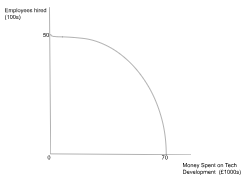
    However, this relies on whether the firm decides to spend more money on employees or on other parts of the business. For example, if the wind turbine firm decides that they want to invest in more maintenance for the wind turbines or even in better better technology for manufacturing the wind turbines.This would mean there wouldn’t be that job vacancy for the unemployed consumer because the firm spent their money elsewhere, creating an opportunity cost (next best alternative foregone). This is seen on the PPF diagram below for the wind turbine firm. If they invested £70,000 in tech development (as a theoretical example), they would no longer be able to higher any employees due to the opportunity cost it creates and vice versa. If they hired 5000 new employees they would no longer be able to invest that money they used into the development of new technologies.

    2 responses to “Assess the likely benefits of the division of labour in the production of wind turbines. (Specialisation and Division of Labour)”

    1. Samuel Avatar
      Samuel

      Nice essay what was ur mark out of 15

      Like

      1. David Ngwu Avatar

        13/15. Hope it helped!

        Like

    Leave a comment

  • 🎓Capitalism and its Critics: A Trip to LSE and a Deep Dive into Economic Systems

    By David Ngwu
    For students curious about capitalism, economic theory, and the ideas shaping the world we live in.

    📚 A Night at the London School of Economics: “Capitalism and Its Critics”

    On the 28th of May, I had the chance to attend a fascinating lecture at the London School of Economics (LSE)delivered by John Cassidy – the author of Capitalism and Its Critics – a recently published book that’s already sparking conversation in academic circles.

    As someone preparing to study economics, I went in equal parts excited and a little nervous. After all, capitalism is one of those big, world-shaping ideas that can feel overwhelming. But the energy in the lecture hall—the buzz of students, faculty, and curious minds—was contagious.

    John Cassidy, a seasoned academic with a background in political economy and economic history, didn’t disappoint. He delivered a talk that was as engaging as it was thought-provoking, tracing capitalism’s evolution and confronting its critics head-on.

    Here’s what stuck with me most:


    ✳️ Capitalism Isn’t One-Size-Fits-All

    One of the most compelling ideas from the lecture was that capitalism isn’t a monolith. It’s not a single, static system but rather something fluid—something that’s morphed over centuries, shaped by culture, politics, and global events.

    “There’s not one capitalism,” Mr. Cassidy explained, “but many versions of it.”

    That’s why capitalism in the U.S. feels different from Sweden’s model—or Japan’s. It’s moulded by the societies it exists in, making it both adaptable and complex.


    So, Why All the Criticism?

    The book (and the talk) didn’t shy away from capitalism’s shortcomings. Some of the common critiques explored included:

    • Inequality – the growing gap between rich and poor
    • Exploitation – workers often don’t receive their fair share
    • Instability – economic cycles of booms and busts
    • Environmental harm – profits prioritized over the planet

    These critiques aren’t new. In fact, many were first voiced in the 1800s by Karl Marx, who famously warned that capitalism contains the seeds of its own undoing.


    🔍 A Nuanced Perspective

    What I really appreciated was the balance in the author’s approach. This wasn’t a capitalist cheerleading session, nor was it a complete takedown. Instead, it was thoughtful, measured, and deeply curious.

    The book asks tough questions: Where does capitalism succeed? Where does it fall short? And what could a better economic future look like?

    For me, it was a reminder that economics isn’t just about data or theory—it’s about people, power, and the choices we make as societies.


    Let’s Take a Step Back: What Is Capitalism?

    Now that you’ve gotten a taste of the lecture, let’s take a closer look at what capitalism actually is—and how it stacks up against other economic systems.

    🧠 The Basics

    At its core, capitalism is an economic system where:

    • Most businesses are privately owned
    • Prices and production are shaped by markets
    • People work for wages, and companies aim for profit

    A simple way to think about it: imagine starting a lemonade stand. You buy lemons and cups, set your prices, and keep what’s left after covering your costs. That’s capitalism in action—on a small scale.

    Zoom out, and you’ll find capitalist systems at work in places like the U.S., Germany, and South Korea—each with its own mix of market freedom and government oversight.


    🧱 Key Features of Capitalism

    FeatureDescription
    Private PropertyIndividuals and companies can own assets and businesses
    Free MarketsPrices are set by supply, demand, and competition
    Wage LaborPeople sell their labor in exchange for income
    Profit MotiveBusinesses strive to earn more than they spend
    Capital AccumulationProfits are reinvested to grow and expand

    Alternatives and the Thinkers Behind Them

    Capitalism isn’t the only way to organize an economy. Let’s look at some other systems—and the thinkers who helped shape them.

    🔴 Socialism (Karl Marx)

    Socialism promotes collective or public ownership of resources. It favors equality and cooperation over profit and competition.

    Karl Marx, one of the most influential critics of capitalism, argued that:

    • Capitalism inevitably creates inequality
    • Workers are underpaid for the value they produce
    • Over time, capitalism would collapse and be replaced by socialism

     Example: In a socialist economy, industries like energy or healthcare might be state-run to ensure equal access for all.


    ⚖️ Mixed Economies (John Maynard Keynes)

    Most modern economies are hybrids. They blend free markets with varying levels of government involvement.

    John Maynard Keynes, a 20th-century British economist, believed that:

    • Capitalism is efficient but often unstable
    • Governments can stabilize the economy through spending during downturns
    • Public services like education and infrastructure are essential for long-term growth

    Example: In the 2008 financial crisis, many governments used Keynesian strategies to avoid deeper economic collapse.


    🟢 Green or Eco-Socialism (Contemporary Critics)

    As climate concerns grow, many argue that capitalism’s growth-at-all-costs mindset isn’t sustainable.

    Thinkers like Naomi Klein and Kate Raworth (author of Doughnut Economics) offer fresh models that:

    • Prioritize ecological limits
    • Shift focus from GDP to overall well-being
    • Encourage circular economies and sustainable living

     Example: The idea of a “circular economy”—where products are reused, shared, or recycled—is central to these new frameworks.


    🤔 Why All This Matters

    Studying economic systems isn’t just academic—it’s a way to better understand the world around you.

    It helps you:

    • See through headlines and political rhetoric
    • Engage with real-world issues like inequality, climate change, and healthcare
    • Think critically about what kind of future you want to help build

    The LSE lecture reminded me that capitalism, for all its strengths, isn’t without contradiction. It can fuel innovation—but also inequality. It can drive prosperity—but sometimes at the cost of stability or sustainability.


    Final Thoughts: Learning from Capitalism and Its Critics

    What stuck with me most is that the book—and the lecture—aren’t trying to crown one system as the winner. Instead, they invite us to think deeply about trade-offs, values, and possibilities.

    Whether your path leads you to finance, policy, activism, or academia, understanding capitalism (and its critics) gives you tools to navigate a rapidly changing world.

    So, if you’re just starting out in economics—or even just curious—I’d highly recommend Capitalism and Its Critics. It’s more than just a book. It’s a doorway into centuries of debate, discovery, and the never-ending question of how we should organize our lives.


    🧭 Want to Keep Exploring?

    Here are a few great places to dive deeper:

    • 📘 The Communist Manifesto – Karl Marx & Friedrich Engels
    • 📘 The General Theory of Employment, Interest and Money – John Maynard Keynes
    • 📘 Doughnut Economics – Kate Raworth
    • 🎥 [YouTube] Crash Course Economics – Quick, engaging intros to economic ideas
    • 🌍 Why Nations Fail – Daron Acemoglu & James A. Robinson

    “A marvellously lucid overview of capitalism’s critics, written in good old-fashioned expository prose”

    -Pratinav Anil

    Guardian

    Leave a comment